Where to See Rice Fields in Ubud
The rice fields around Ubud are not all the same, and the difference matters more than most itineraries acknowledge. Some are terraced hillsides viewed from a platform above them. Others are walked through, at water level, with the paths between the paddies narrow enough that you have to step sideways to let a farmer pass. The second version is the one worth finding.
Knowing where to see rice fields in Ubud that actually feel like something, rather than something to photograph from a distance, comes down to a few specific places and the times you arrive at them.
Tegallalang
Tegallalang is the most visited and also the most genuinely impressive. The terraces north of Ubud drop steeply into a valley in a way that requires seeing in person before the scale registers. The photographs flatten it.
Go before 8am. The vendors and swing operators arrive mid-morning, and by noon the viewpoints are crowded enough that it stops feeling like a rice field and starts feeling like an attraction. In the early morning, with mist still sitting in the lower terraces, it is extraordinary.
Worth walking below the road-level entry point, down into the valley, where the irrigation channels run and the working parts of the field become visible.
Campuhan Ridge Walk
The ridge walk doesn’t pass through rice fields exactly, but runs between two river valleys with active cultivation visible on the slopes below. Green and continuous, without the vendor activity of Tegallalang, best before 8am for the light and the quiet.
Around 45 minutes at an easy pace. The fields are part of what you’re moving through rather than something you stop to see.
The Paths Around Nyuh Kuning
South of the Monkey Forest, the village of Nyuh Kuning has working paddies accessible by narrow lanes that most visitors don’t find because there’s nothing signposting them. These are small-scale, active, unglamorous fields that are doing what rice fields actually do rather than being arranged for viewing.
Walk out from the southern edge of the village in the early morning and follow the path that runs along the irrigation channel. It doesn’t go anywhere particular. That’s the point.
Jatiluwih
Further afield, roughly an hour from Ubud, Jatiluwih is a UNESCO-listed rice terrace landscape of a different scale entirely. The terraces here are ancient, part of the subak irrigation system that has governed Balinese water management for over a thousand years. The views are wide and the visitor numbers lower than Tegallalang.
Worth the drive for a half-day if the Ubud area terraces have already been seen.
Starting Close to the Fields
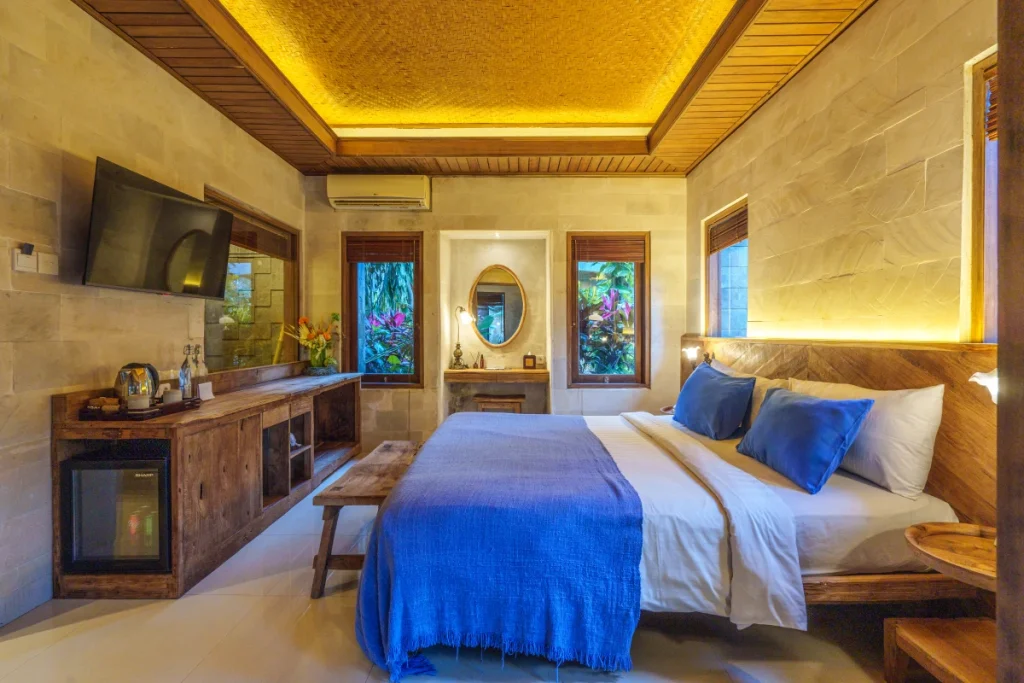
Where to see rice fields in Ubud works best when the accommodation is already in the quieter agricultural edge of town rather than requiring a long drive to reach the views. Radha Phala Resort & Spa sits in this part of Ubud, where the fields are close and the morning walk to them is a short one rather than a scheduled excursion.
If you want the rice field walks to be a morning habit rather than a day trip, Radha Phala Resort & Spa is worth considering as the place to be based.